
.svg)
Spring on the Mount Washington Cog Railway
FEATURED:Spring Might Be the Best Time to Ride
Discover


There’s something about spring in the White Mountains that feels earned. After months of snow, wind, and long stretches of winter silence, the landscape begins to shift. It doesn’t happen all at once. It unfolds slowly, patches of green returning to the valley floor, streams running stronger with snowmelt, and the first bursts of color appearing where you might not expect them.
And then, almost suddenly, the lupines arrive.
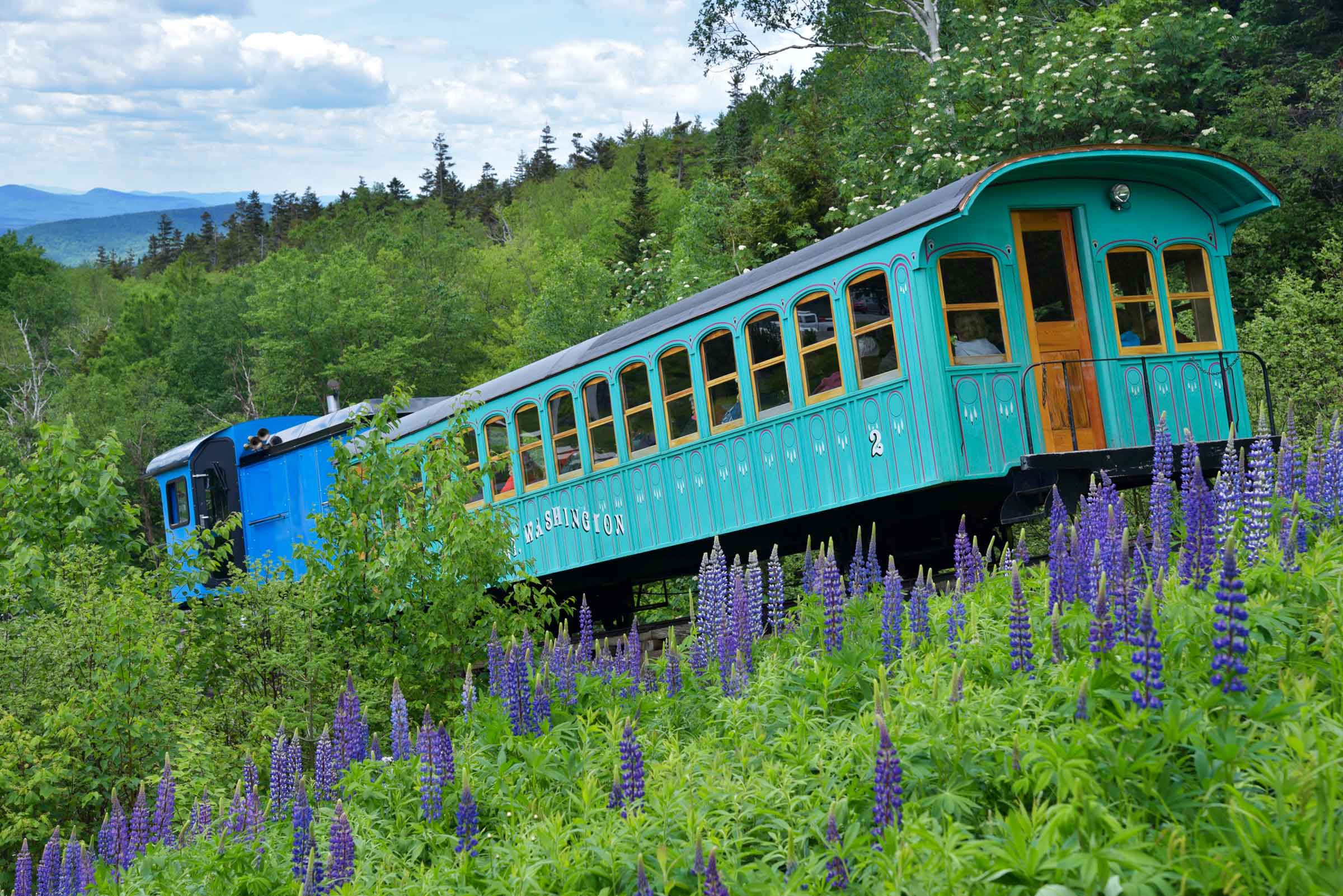
At the base of Mount Washington, near the historic grounds of the Mount Washington Cog Railway, these wildflowers begin to bloom in late spring, creating one of the most quietly beautiful scenes in all of New England. Purple, pink, and blue hues spread across the landscape, set against the backdrop of the Presidential Range, a contrast that feels almost too perfect to be real.
But the lupines are only the beginning. Because from this moment, standing among spring’s first colors, you board a train that doesn’t just take you up a mountain. It carries you through history, across shifting ecosystems, and into one of the most extreme and unforgettable environments in the Northeast.
This is spring on the Mount Washington Cog Railway. And it’s unlike anything else in New England.
Before you even step aboard, it’s worth understanding just how improbable this experience is.
The Mount Washington Cog Railway is the first mountain-climbing cog railway in the world, completed in 1869. At the time, the idea of building a train that could climb the steep western face of Mount Washington was widely considered impossible. The mountain itself rises to 6,288 feet, and its slopes are unforgiving - steep, rocky, and exposed to some of the harshest weather conditions in North America.
But Sylvester Marsh, the railway’s founder, believed it could be done. Using a system of gears and a central rack rail, Marsh designed a train that could steadily climb grades far too steep for conventional railroads. It was an engineering breakthrough, and more than 150 years later, the Cog Railway still operates using that same fundamental concept - a testament to both ingenuity and persistence.
In spring, when the snow begins to retreat from the tracks and the trains resume regular trips up the mountain, you’re not just boarding a scenic excursion. You’re stepping into a living piece of American engineering history.
The experience starts at Marshfield Base Station, located at the foot of Mount Washington along the western slope. In early May, this area feels like it’s waking up. Snow may still linger in patches, especially in shaded areas, but the ground begins to soften. Streams run alongside the tracks, carrying fresh meltwater down from the mountain. And most notably, the lupines begin to emerge, first as hints of color, then as full fields of blooms that stretch across the landscape.
These wildflowers thrive in this environment, where the soil, sunlight, and mountain air come together in just the right way. Their timing is fleeting, which makes their appearance all the more special. For a few short weeks, they transform the base of the mountain into something unexpectedly vibrant.
It’s a moment of contrast.
Behind you, spring is arriving.
Ahead of you, winter still holds on.
And right in front of you, the train waits.
One of the most remarkable aspects of the Cog Railway in spring is how quickly the landscape changes as you climb. The journey to the summit takes roughly an hour, but in that time, you pass through multiple ecological zones, each one telling a different story about the mountain.
At the lower elevations, the forest begins to come back to life. Trees show early signs of budding. The air feels milder. The ground, though still damp from winter, carries the unmistakable scent of spring.
As the train climbs higher, that softness begins to fade. The trees grow shorter. The colors shift. Snow becomes more consistent along the slopes. By the time you reach the upper elevations, you’re in a completely different world — one that looks and feels much closer to late winter than spring. Mount Washington is famous for its extreme and unpredictable weather, and that reputation doesn’t take a break in May. It’s not uncommon for the summit to still be covered in snow while the base is experiencing one of the first warm days of the season.
That contrast is part of what makes the journey so compelling.
You don’t just travel upward.
You travel through time, from spring back into winter.
There’s a rhythm to the Cog Railway that sets it apart from any other train ride. It’s not fast. It’s not quiet. And it’s not trying to be. The train climbs steadily, powered by its unique gear system, creating a sound that becomes part of the experience - a mechanical cadence that feels both historic and purposeful. You feel the incline. You sense the effort. And as the views begin to open up behind you, you realize just how far you’ve come.
On clear days, the scenery is expansive. The White Mountains stretch outward in every direction, ridgelines layered against the horizon. In spring, the contrast between snow-covered peaks and greening valleys creates a visual depth that’s hard to replicate at any other time of year.
The conductor often shares insights along the way, stories about the railway’s history, the mountain’s weather, and the unique challenges of operating in such an environment. It adds context without overwhelming the experience.
Mostly, though, the journey invites you to look outward.
To watch the landscape change.
To feel the temperature drop.
To notice how quickly the world below begins to feel distant.
Reaching the summit of Mount Washington in spring is a reminder that seasons don’t arrive everywhere at once. At 6,288 feet, the conditions at the top can be dramatically different from those at the base. Snow often lingers well into late spring. The wind can be sharp and unrelenting. And the air carries a clarity that feels almost alpine.
This is home to the Mount Washington Observatory, known for recording some of the most extreme weather ever measured, including historic wind speeds that have made headlines around the world. It’s a place defined by exposure - to the elements, to the sky, and to the vastness of the surrounding landscape. On clear days, the views are extraordinary. You can see across New Hampshire, into Maine, Vermont, and even into Canada. In spring, those views are layered white peaks, dark forests, and the first hints of green beginning to take hold far below.
It’s a moment that stays with you. Because while the lupines bloom at the base, and spring begins its work in the valleys, the summit reminds you that winter doesn’t let go easily up here. And that’s part of the magic.
Summer brings crowds. Fall brings foliage. Winter brings snow-covered drama. But spring offers something different. It offers contrast. It’s the only time of year when you can stand among blooming wildflowers at the base of Mount Washington and, within an hour, find yourself surrounded by snow at the summit. It’s a season defined by transition - by movement, by change, by the sense that something new is beginning.
The Cog Railway captures that perfectly. It doesn’t rush the experience. It lets you see it unfold.
From lupines in bloom to lingering snowfields, from valley warmth to summit chill, the journey becomes a reflection of the season itself.
For those looking to experience the Cog Railway in spring, timing matters. The lupine bloom typically begins in mid-to-late May, depending on weather conditions, and can last for a few weeks. It’s worth keeping an eye on updates from the railway as the season approaches, as conditions on Mount Washington can shift quickly.
Spring weather also means being prepared. Temperatures at the summit can be significantly colder than at the base, so dressing in layers is essential. What feels like a mild spring day below can feel like winter at the top.
But that’s part of the experience.
You’re not just visiting a destination.
You’re moving through one.
The Mount Washington Cog Railway is often described as a scenic train ride, and it is. But in spring, it becomes something more. It becomes a journey through seasons, through history, and through one of the most unique landscapes in the Northeast. The lupines may draw you in, and rightly so. Their brief, beautiful bloom sets the stage for something memorable.
But it’s the climb - the steady, deliberate ascent into a different world, that defines the experience. Spring doesn’t arrive all at once on Mount Washington. It rises slowly. And there may be no better way to experience that than from the seat of a train that’s been making the journey for more than 150 years.